
Scaling UX Through Systems, Not Headcount
Dates: 2024 - Present
Roles held: UX Manager of AFT Experience Design. This includes labor planning, package flow, workplace health and safety, inbound, outbound and quality control product experiences.
Overview:
As organizations grow, UX challenges rarely come from a lack of design talent. They emerge when demand for UX outpaces the structures designed to support it.
While leading UX within Amazon Fulfillment Technologies, I encountered this problem at scale. The organization was responsible for a rapidly expanding ecosystem of operational tools, supporting global, high-risk workflows across planning, safety, and execution. UX demand grew faster than available capacity, and traditional embedded models could no longer keep pace.
Rather than treating this as a resourcing problem, I approached it as a systems design challenge:
How do you scale UX impact, quality, and trust without scaling headcount linearly?
- Reframing the Problem: UX as an Organizational System -
Rather than treating this as a resourcing or prioritization problem, I reframed it as a systems design challenge. Scaling UX impact required shifting focus from individual product execution to the structures, mechanisms, and decision frameworks that shaped how UX functioned across the organization.
My role expanded beyond product leadership to include defining how UX engaged with teams, how quality was established and maintained, and how designers’ time was applied where it mattered most. This meant creating clarity for product and engineering partners around when deep UX involvement was required and when teams could move independently using shared guidance and standards.
The goal was not to reduce UX rigor, but to preserve depth where risk was highest while enabling speed elsewhere. Treating UX as a system made it possible to reason about scale intentionally rather than reactively.
Designing a Scalable UX Operating Model
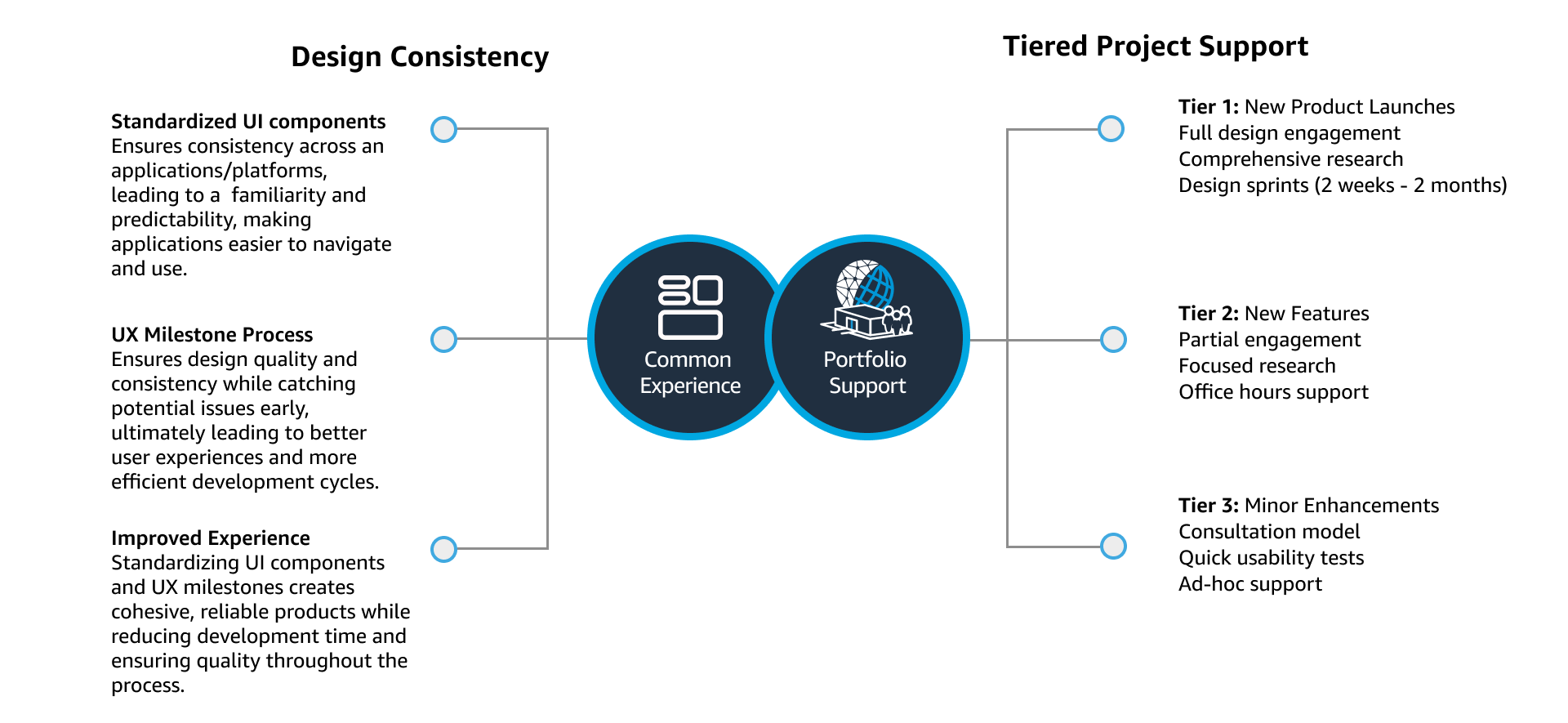
To support this shift, I helped design and implement a portfolio-based UX operating model centered on leverage, reuse, and intentional focus. UX engagement was aligned to risk and impact through a tiered approach that distinguished between net-new platforms, significant workflow expansions, and incremental improvements. This allowed deep research and end-to-end design leadership to remain focused on high-impact initiatives while enabling lower-risk work to proceed through consultation, standards, and targeted reviews.
Time-boxed design sprints became a critical mechanism within this model. By bringing design, research, product, and engineering together early, sprints helped teams align on user needs, mental models, and success criteria before significant development investment. This approach consistently compressed multi-month discovery and alignment cycles into weeks, while reducing downstream churn and uncertainty.
To maintain a high quality bar at scale, I also implemented a UX milestone review system that shifted validation earlier in the lifecycle. Early design deep dives ensured alignment on direction and mental models, UX sign-off checkpoints validated usability and consistency before implementation hardened, and fit-and-finish reviews assessed near-final experiences prior to launch. Together, these mechanisms created predictability, reduced late-stage surprises, and reinforced UX as a shared responsibility across disciplines.
Results & Impact
This operating model fundamentally changed how UX scaled across the organization. Experience quality became more consistent across tools, delivery cycles shortened without lowering the quality bar, and teams gained clearer expectations around how and when UX would engage. Designers were able to focus more deeply on high-impact problems, while product and engineering teams became better equipped to make informed design decisions independently.
The shift reduced duplicated effort, minimized late rework, and increased confidence in UX guidance. Over time, UX was no longer perceived as a bottleneck or an approval gate, but as an enabling system that supported speed, reduced risk, and improved decision-making across complex operational workflows.
Most importantly, the organization moved from relying on individual heroics to relying on repeatable structures that produced consistent outcomes.
What This Demonstrates About My Leadership
This work reflects how I approach design leadership in complex environments. I treat UX as an organizational system rather than a service function, focusing on structures that allow quality and impact to scale sustainably. I prioritize clarity, consistency, and trust, balancing speed with rigor and autonomy with standards.
By designing the conditions under which good design can happen repeatedly—rather than optimizing for one-off success—UX becomes durable, credible, and deeply embedded in how organizations operate. These principles continue to guide how I lead teams, shape design strategy, and build systems capable of supporting complexity at scale.